 Aug 19, 2025
 Comments
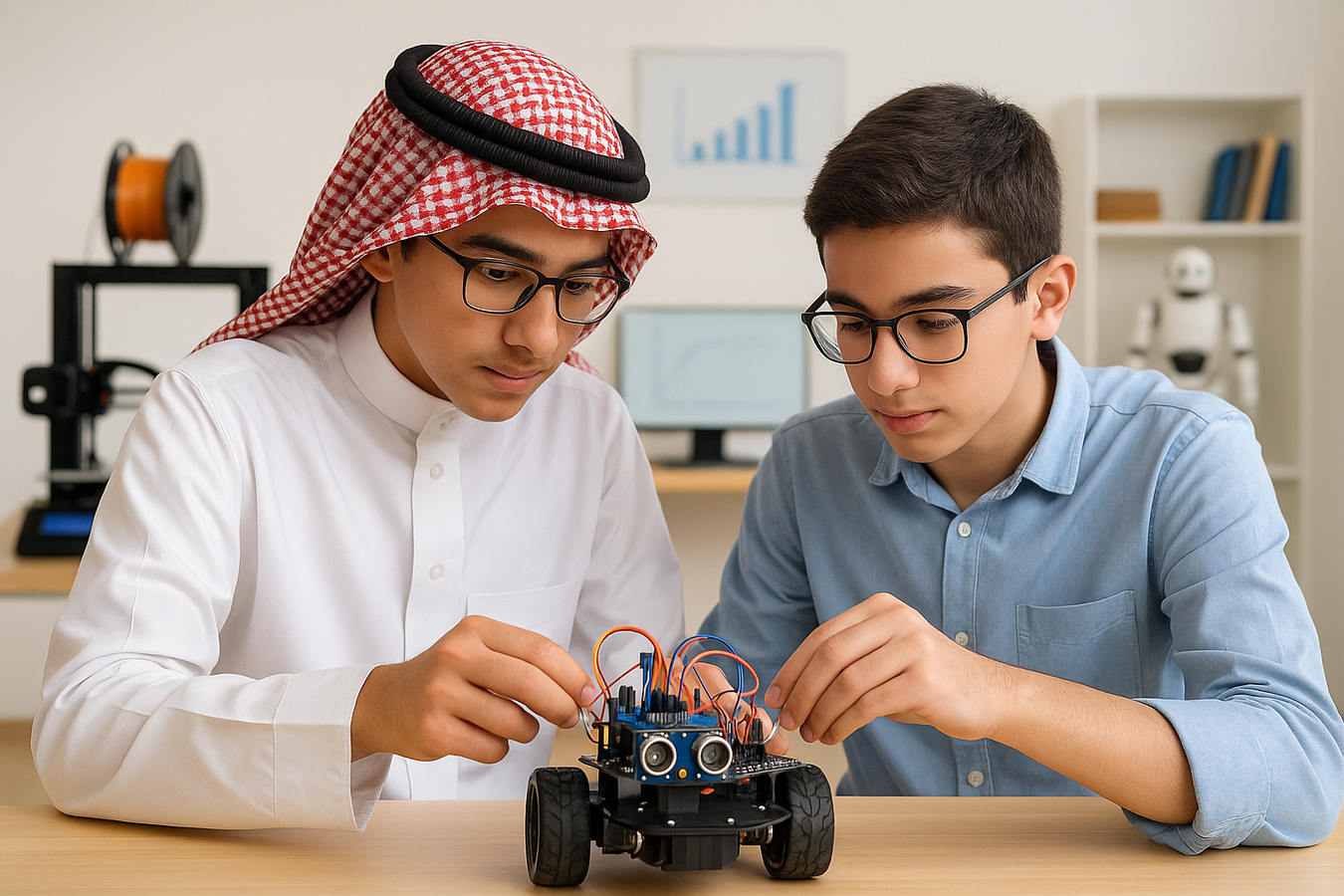
In a school system long shaped by rote memorisation and high-stakes exams, Saudi Arabia is testing a new formula: identify technical talent early and train it not for university entry, but for the future of work.
This shift is taking place in the form of five new specialised technology high schools launched across Saudi Arabia — in Riyadh, Medina, the Eastern Province, Qassim, and Jeddah. Launched by the Ministry of Education in partnership with Tuwaiq Academy, a national tech training institute known for its intensive bootcamps in AI, cybersecurity, and software development, the schools are designed for first-year secondary students who show exceptional aptitude in technical fields. Their mission is clear: to grow homegrown engineers, programmers, and digital thinkers before graduation age.
Saudi Arabia is not alone in this pivot. Singapore has long run early talent-identification programmes such as the School of Science and Technology and NUS High School, designed to train students from age 13 in applied sciences. In Germany, vocational schools and Berufsschulen integrate real-world technical training with classroom learning. Even in the UK, which has long debated the purpose of secondary education, specialist technical colleges are slowly making a comeback. Saudi Arabia’s move echoes these efforts — but with the urgency of a country undergoing rapid socio-economic change.
A prototype school in Riyadh that opened in late 2024 offered the first glimpse. Unlike traditional high schools, its corridors are lined with 3D printers and interactive screens, not dusty cabinets and framed Quranic verses. The school blends the national curriculum with hands-on projects, leadership workshops, and short-form tech bootcamps. Students take part in hackathons, build autonomous vehicles, and pitch app ideas before mock investors. Private-sector partners help shape the curriculum, ensuring it keeps pace with the demands of an AI-driven global economy.
In one classroom, 15-year-old Faisal is writing his first lines of Python. Around him, classmates are sketching robotic limbs and prototyping drone navigation tools. “I want to build something real,” Faisal told Saudi Times. “It’s not just about marks anymore. It feels like we’re being trained for the world.” Another student compared it to “learning the language of the future,” saying he had never imagined school could feel like a startup.
The excitement is palpable — but so is the context. With nearly 60% of the Saudi population under the age of 30, and a private sector still heavily reliant on expatriate labour, the pressure to equip young Saudis with competitive skills is mounting. While traditional high schools have largely focused on preparing students for university admissions, often through memorisation-heavy instruction, these new tech schools aim to bridge a different gap — the one between education and employment.
According to the World Bank, fewer than 20% of secondary students in the Gulf receive formal training in technical fields, compared to over 50% in some OECD countries. The demand for such education, however, is growing fast. Saudi Arabia’s burgeoning tech sector — from smart cities to fintech — needs skilled labour, not just degrees. Projects like NEOM and the National Strategy for Data & AI are no longer abstract; they are hiring pipelines that require talent trained in code, systems thinking, and problem-solving.
Parents are slowly warming to the change. A decade ago, few Saudi families would have considered enrolling their child in a technical high school. It was seen as less prestigious, more like a fallback path. Today, those same parents attend orientation sessions asking detailed questions about AI competitions, cloud computing certifications, and the international transferability of their child’s training. “People used to ask, ‘Will my son even get into university after this?’” said a programme advisor in Riyadh. “Now they ask if he’ll be ready to launch a company before 18.”
The new schools reflect more than economic planning — they signal a cultural shift. For decades, Saudi Arabia’s best and brightest were sent abroad to learn and return with expertise. Now, Saudi Arabia is investing in growing that expertise at home. In doing so, it is challenging deeply embedded social norms — about status, education, and the perceived value of intellectual labour.
Other countries offer cautionary tales. In the US, for example, early specialisation in STEM has sometimes come at the cost of critical thinking and creativity. Critics argue that narrow technical training can limit intellectual breadth or reduce education to workforce prep. Saudi officials are aware of these concerns. That’s why the model includes leadership training, soft skills workshops, and project-based learning intended to broaden — not narrow — the student’s development.
And yet, the wager is unmistakable: build technical competency early, and the country can localise knowledge that once had to be imported. Rather than wait for university graduates or foreign contractors, Saudi Arabia is starting with teenagers — teaching them to write the software, build the sensors, and engineer the tools that will drive its future economy.
Whether these students become the architects of that future remains to be seen. But the bet is bold. In a society where opportunity once came with age and foreign diplomas, a new generation is being told: start now. For Faisal and his classmates, the most important lesson may not be in code — it may be in confidence.










 Oct 21, 2026


0 Comments
No comments yet. Be the first to comment!