 Jul 18, 2025
 Comments
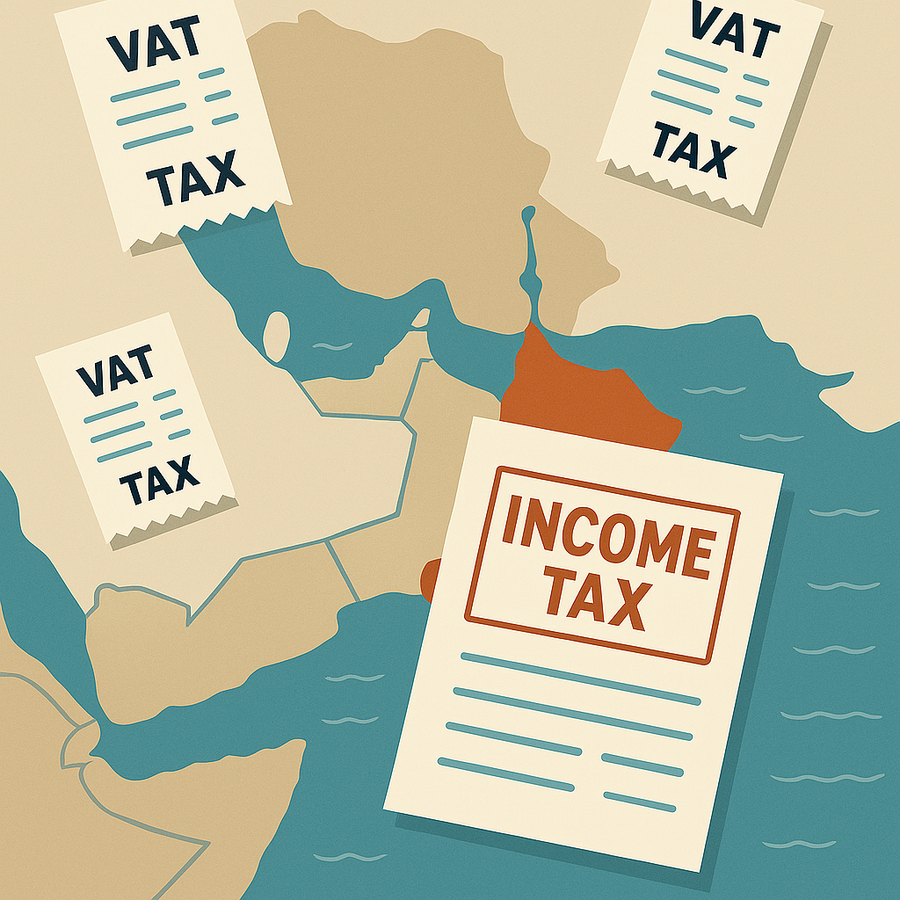
Oman has done what once seemed unthinkable in the Gulf: it’s introducing income tax. Starting in 2028, individuals earning more than 42,000 Omani riyals (around $109,000) will pay a 5% tax on their income — the first such measure in the region. Officials say the move is designed to promote fairness and reduce reliance on oil revenues, which still account for about 70% of Oman’s state budget. While only a small portion of the population will be affected, the decision has sent ripples across the Gulf.
At first glance, this might appear to concern only Omanis. But that would be a narrow reading. For the rest of the Gulf, it’s a warning shot — and a sign of what may lie ahead.
For decades, the concept of taxation felt foreign to many in the region. We understood it abstractly, of course. Some of us saw it printed on receipts in Cairo or during shopping trips in Europe. Others, holding U.S. passports, grew up knowing what it means to file taxes each year — willingly or not. But income tax as a domestic reality? That was something else entirely.
The idea lingered in the background, especially as oil prices fluctuated and budgets tightened. Still, it was unsettling. The introduction of VAT in countries like Saudi Arabia, first at 5% in 2018 and later tripled to 15% during the pandemic, took many out of their comfort zones. But it also prompted a shift in how people thought about spending. Suddenly, every purchase felt a bit more deliberate. People began to reconsider what they needed — and what they didn’t. Subsidies once taken for granted, like electricity and fuel, started to carry visible costs. A television left running for hours, or a brightly lit house at midday, no longer felt harmless.
Oman’s officials have presented the measure as more than just a financial necessity. “The purpose of the tax is to diversify sources of income and achieve financial sustainability,” said Ahmed al-Hutti, chairman of Oman’s Tax Authority, as quoted in The New York Times. “This is the beginning of a new phase for Oman.”
That “new phase” is not just economic — it is social. In Gulf societies, the unspoken deal has long been clear: the state provides, the citizen receives. This model, reinforced by oil wealth and generous subsidies, shaped expectations across generations. Taxation challenges that equation. It implies not only giving back to the state but also participating more actively in how resources are allocated — a shift from passive entitlement to engaged citizenship.
Across the Gulf, such a phase has long been deferred. Gulf countries rank among the world’s lowest-tax environments, with income tax absent in all six Gulf Cooperation Council (GCC) states — until now. While most have implemented VAT, personal income tax has remained off-limits, politically and socially.
But Oman’s move could reshape expectations. Taxation invites a different kind of thinking. It encourages people to ask where their money goes — and why. It prompts interest in public budgets, infrastructure, and education. It can also plant the seeds of accountability — not just on the state’s part, but on the part of citizens too. For societies accustomed to relying on the state for support — from subsidised electricity to near-free healthcare — this is a subtle but meaningful cultural shift.
Not everyone in Oman is enthusiastic. As The New York Times reports, reactions range from cautious optimism to concern about the timing and administration of the tax. But there’s also a recognition that change is coming — and that preparing for a post-oil future requires difficult decisions.
Saudi Arabia’s experience offers a glimpse of how quickly these changes can become reality. According to the Saudi Ministry of Finance, non-oil revenues reached SAR 502.5 billion ($134 billion) in 2024, up 9.8% from the previous year, thanks largely to VAT and customs duties. Nevertheless, oil revenues still accounted for around 60% of total government income — about SAR 756.6 billion. In other words, taxes are growing, but the region remains far from post-oil independence.
Taxation, however limited, can trigger broader cultural shifts. When people contribute directly, they begin to care more — not just about how much they pay, but about how wisely it’s spent. In that sense, Oman’s move is not only a fiscal policy but a social milestone. It challenges the historical model of one-sided support and instead proposes a more balanced relationship between state and society.
For others in the region, Oman’s step may be a sign of things to come. It’s not just about balancing budgets. It’s about encouraging a mindset that sees consumption, citizenship, and public spending as part of the same conversation. As Gulf populations grow and demands on public services increase, governments may no longer be able to offer everything for free — nor should they.
Oman has taken the first step. The rest of the Gulf may not be far behind.










 Sep 24, 2026

0 Comments
No comments yet. Be the first to comment!