 Aug 8, 2025
 Comments
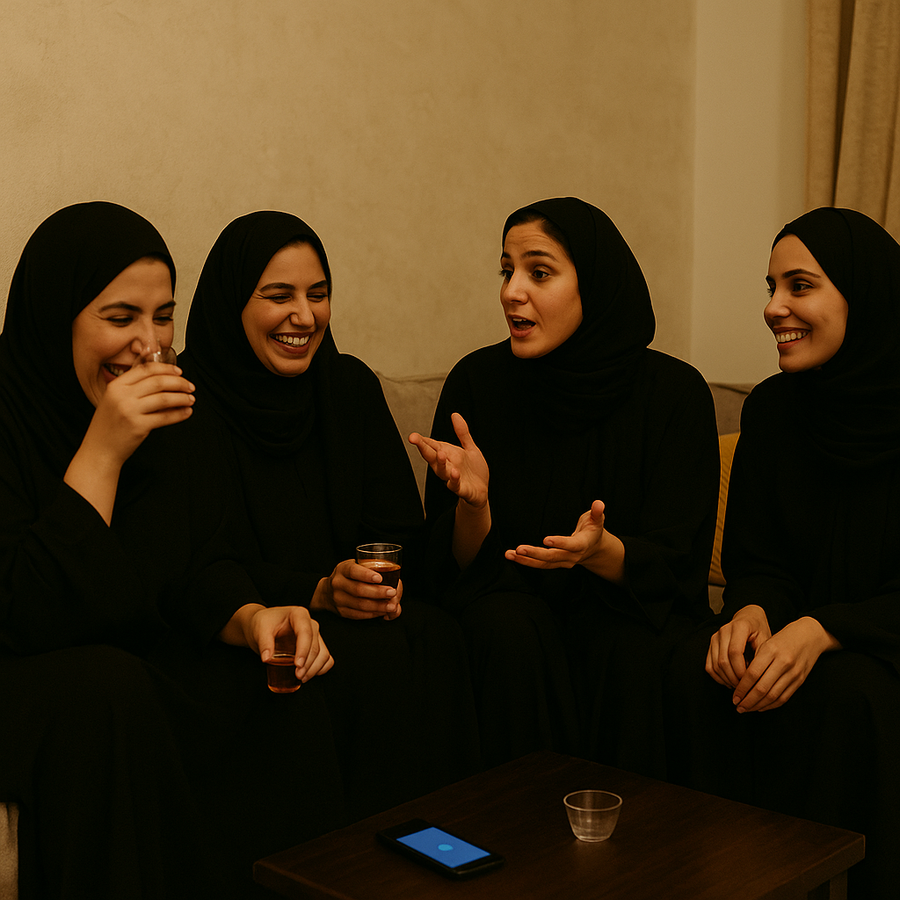
One of the least studied yet most essential features of Saudi society is its unique sense of humour. Saudi humour doesn’t announce itself. It appears in offhand comments, in weary sighs at traffic lights, or in dry one-liners exchanged between strangers. It is not scripted for performance but lived — and often, unintentionally hilarious.
To understand Saudi humour, one must first remember that Saudi Arabia is far from culturally uniform. Its vast geography houses a wide spectrum of dialects, temperaments, and worldviews. I lived for many years in Jeddah, the country’s coastal melting pot, where the Jeddah dialect sounds softer, more fluid, seasoned by Egyptian and Sudanese influences, shaped by centuries of trade and pilgrimage. There, language rolls off the tongue with a looseness that lends itself to wit and Jeddawi humour.
In contrast, the dialects spoken in Riyadh or the Eastern Province echo more of the Gulf region — tighter, more clipped, less prone to playful digressions. I’m no expert in dialects, but I suspect these linguistic textures influence how humour is delivered and received. Jeddawi jokes, in particular, are rarely dramatic. They are dry, observational, often so casual they might be mistaken for sincerity. Their genius lies in how close they stay to reality.
Much of this Saudi comedy also stems from a cultural trait rarely discussed: Saudis aren’t especially fond of objectivity, at least not in the way Western societies often prize it. What is funny is usually deeply personal. If it didn’t happen to you, it happened to someone you know. This is partly why many of Saudi Arabia’s best-known comedians hail from the western region. They don’t try to be universal — they speak from memory, from home, from lived contradiction.
Recently, while deleting old messages, I stumbled across a folder I didn’t even realise I’d been curating: saved text messages and WhatsApp voice notes that made me laugh — not because they were jokes, but because they weren’t.
One man, commenting on the rise in VAT, said dryly: “At least now I’ll see my wife’s real face. She might stop using so much makeup.” Another, responding to the announcement of new entertainment reforms, remarked: “I want compensation. I grew up in the 80s when fun was banned, and the 90s kids came back from Afghanistan.”
Much of this Saudi humour vanishes in translation — not just the words, but the cadence, the tone, the resigned delivery. These are essential elements that make something funny not on paper but in person. Like humour anywhere, it is coded: you need to know how to listen.
Still, I’m partial to the Jeddawi accent. It’s not just about pronunciation — it mirrors the city’s personality: relaxed, ironic, sharp without being aggressive. There’s a certain understated confidence to it. And like the city itself, it doesn’t try too hard to impress. It knows it’s been through enough to laugh at the mess of it all.
Even within the western region, variety abounds. Mecca’s dialect tends to be fast-paced, reflecting the city’s intense rhythms, while Madinah’s dialect is slower, cooler, and dignified. Each city’s way of speaking is a cultural map of its people.
If Saudi humour had a home, it would be in those overlooked corners — in voice notes, TikTok comments, majlis banter, and late-night debates that start with parking violations and end with existential truths. It’s not necessarily crafted for the stage (though some try); it lives in the everyday and is shaped by a generation that has had to navigate change at a dizzying pace. In a country where reforms came faster than furniture deliveries, Saudis have mastered the art of laughing while adapting.
In the end, Saudi humour is not an escape from reality — it’s a way of surviving it. It gives form to frustration, rhythm to monotony, and relief to the heaviness of things left unsaid. More often than not, it slips quietly past outsiders but is deeply appreciated by those who understand its cultural code.
And that’s why my phone is full of it.









 Oct 21, 2026

0 Comments
No comments yet. Be the first to comment!